vintage and contemporary postcards and stamps from around the world


Showing posts with label New Brunswick. Show all posts

30 January 2026

legislative assembly building

The New Brunswick Legislative Assembly Building stands out for the mansard roofs. The Second Empire style building in Fredricton was built in 1882 after the previous one was destroyed by fire. 

It's a shame you can't see the central octagon domed tower in this 1970's era prepaid postcard


23 August 2023

12 May 2020

calm

The province of New Brunswick has a population of around 776,800 people.
The only province to report no deaths from Covid-19.

27 October 2019

Confederation Bridge

Too big for not just one stamp, but also two stamps. The Confederation Bridge links New Brunswick with Prince Edward Island. It is 8 miles long (12.9 km) and is the world's longest bridge over ice-covered waters (the Northumberland Strait). And I would need to be seriously tranquilized to drive over it. There is a shuttle service for cyclists and pedestrians.
The Cape Jourimain Lighthouse is on the New Brunswick side. It has been decommissioned since 1997 with the opening of the bridge and the end of the ferry service. Now, the area surrounding the lighthouse is a natural wildlife reserve.

for Sunday Stamps - bridges

05 September 2019

second longest

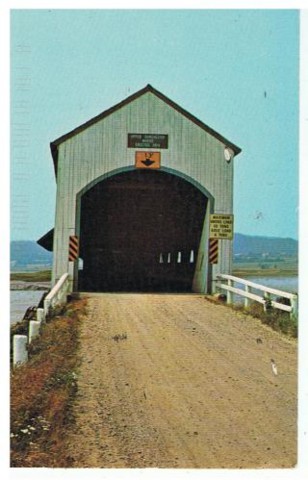
Another covered bridge, but this one doesn't have a stamp dedicated to it.
The Upper Dorchester Covered Bridge near Sackville New Brunswick.
Memramcook River.
Known as the "second longest covered bridge in the world"

22 July 2017

covered bridge

1970s Canada Hartland Covered Bridge
photo by E Otto

This 391m bridge was opened in 1901 but wasn't covered until 1922 after repairs were needed when it was seriously damaged by ice in the St John River.   The signs on the front say
Hartland
New 
Brunswick

Welcome
you are now entering the longest
covered bridge in the world
1282 feet


22 April 2017

flowerpots

The flowerpots in Tobermory on Georgian Bay were formed after years of rain, wind, waves and ice wore away at the cliff at the water's edge. The softer rock eroded more quickly until the shape of a 'flowerpot' emerged from the harder rock.

The flowerpots in Hopewell Cape on the Bay of Fundy have been formed by tidal erosion. The Bay of Fundy has the highest tides in the world. The extremes mean that the base of these rocks are covered in water twice a day. The only way to view them at ground level is at low tide.

In 1903, one of the three stacks at Flowerpot Island collapsed.
In 2016, part of one of the Hopewell Rocks - Elephant Rock - collapsed.

here is a drone view of the collapse
https://youtu.be/vxNKBukqOOU