vintage and contemporary postcards and stamps from around the world


28 August 2016

Sunday Stamps II - 89

1968, Canada, Armistice, 1918-1968
Vimy Memorial

designed by Harvey Thomas Prosser
engraved by Yves Baril (picture) and Gordon Marsh (lettering)
based on the Walter S Allward sculpture

The Vimy Memorial was unveiled in July 1936, on 100 ha of land on Vimy Ridge that was granted to Canada by France to be used 'in perpetuity' as a memorial park with a memorial dedicated to Canadian war dead. The Battle of Vimy Ridge was the first time that all four division of the Canadian Expeditionary Force participated together and it became a national symbol of achievement and sacrifice. The two limestone pylons of the monument rise 125' and has many stylized figures. This stamp shows the 'Breaking of the Sword' - three young men, with one crouching and breaking his sword, meant to represent the "defeat of militarism and a general desire for peace".

"Vimy Ridge is one of Earth's altars on which Canadians sacrificed for the cause of humanity"
~ William Lyon Mackenzie King

for monuments

21 August 2016

Sunday Stamps II - 88

1956, Bulgaria, Olympics

In 1956, the Summer Games were held in Melbourne and were the first to be held in the southern hemisphere as well as the first to be held outside Europe or North America. Bulgaria issued a set of 6 stamps which included this one for gymnastics. The others in the set were for boxing, discus throw, pole vaulting, soccer, and basketball. That year, Bulgaria would win a bronze in football/soccer with 3 silver and a gold for wrestling. Women's gymnastics would be dominated by the Soviet Union and Hungary while the Soviet Union and Japan would dominate men's gymnastics.

for Olympics

14 August 2016

Sunday Stamps II - 87

2010, Japan

Another of Japan's wildly popular Hello Kitty series was issued in 2010 for that year's Expo in Shanghai China. She is depicted in a heart shaped stamp surrounded by chrysanthemums. Hello Kitty is an anthropomorphic white Japanese Bobtail cat who was first introduced by the Sanrio company in 1974. She is an essential part of kawaii - the quality of cuteness in Japanese culture. Originally marketed for young girls, by the 1990s her target was expanded to include teens and adults as a retro brand. Even though she was created by a Japanese market, and is a breed that's native to Japan and Southeast Asia, she was actually born in the suburbs of London and has a large family, including a twin sister. You can tell them apart by the bows in their hair - Kitty White (her 'real' name) wears a red (or pink) bow on her left ear, while Mimmy White wears a yellow bow on her right ear.

for odd shaped stamps

07 August 2016

Sunday Stamps II - 86

1934, USA, National Parks

Crater Lake, in Oregon, was formed around 7,000 years ago after the eruption of Mount Mazama. There are no rivers flowing into or out of the lake but the amount of rain and snowfall ensures that every 250 years the total amount of water is replaced. For this reason, Crater Lake has some of the world's purest water. It is famous for its clear, deep blue colour - which is represented in this stamp. This is one of a set of 10 stamps issued from July - September, 1934 to commemorate National Parks Year. 

for lakes and/or rivers

31 July 2016

Sunday Stamps II - 85

2013, Czech Republic, Horses
designer: Peter Oriesek

The Chumlec horses from the Kinsky stud farm are among the best horses bred in the Czech Republic. They are admired for their extremely glossy, almost metallic, golden colour as much as for their stamina, athleticism and good character.  During the Prussian War, the Kinsky's, a member of the Bohemian nobility, were ordered to develop their stud farm and breed good quality horses for the elite cavalry. Apart from military and police, they are best suited for dressage, steeplechases, show jumping, fox hunting and polo.

For: horses

24 July 2016

Sunday Stamps II - 84

2014, additional postage ¥18 for Celebrations                         2014, ¥52 for Happy Greetings
Designer: Hoshiyama Ayaka                                                 Designer: Nakamura Hitomi


Issued in October of 2014 for New Year, this temporary stamp (left) makes up the difference of domestic rate and international postage for postcards. It is common in Japan to send postcards to arrive on New Year's Day. This is one of the two most popular cuisine (the other stamp in the set shows tempura). The 52 yen stamp is the regular rate and was issued for the "greetings" theme and shows a pagrus major (or, in Japanese,  madai) which is prized for its flavour and for its traditional use as a food of good fortune often served at New Year or for other festive occasions.

for food

17 July 2016

Sunday Stamps II - 83

1958, Canada International Geophysical Year
designer: Alan Pollock

The International Geophysical Year was an international scientific project that ran from July 1 - Dec 31, 1958 and had 67 nations participating. The focus was on studies of the universe in all parts of the world and encompassed eleven earth sciences, including meteorology, oceanography, seismology, solar activity, geomagnetism, cosmic rays, aurora, gravity and longitude and latitude determinations for precise mapping. Some of the legacies of the ICY lead to the creation of the Antarctic Treaty and the World Data System both of which encourage free exchange of scientific information across international borders.

for science

10 July 2016

Sunday Stamps II - 82

2010, Russia, Cities of Military Glory

Each of the five stamps in this set is exactly the same, save for the name of the city written in gold foil on the top. In this case, it is Luga. The other cities are: Malgobek, [Y]Elnya, [Y]Elets, and Voronezh. The stamps are square, measuring 37mm x 37mm and valued at 10 rubles. Luga was given the status of "City of Military Glory" by Vladimir Putin in 2008 for "courage, endurance, and mass heroism, exhibited by the defenders of the city in the struggle for freedom and independence of the Motherland". In 2010, Luga had a population of around 38,600. It's located 140km south of St Petersburg. During WWII, seven regular militia and irregular divisions in the Luga area halted the advance of the German army and delayed the Siege of Leningrad by over one month. The German occupation of Luga lasted from August 1941-February 1944.

for the colour Red

03 July 2016

Sunday Stamps II - 81

1961,  France  "14 Juillet" R de la Fresnaye

14 July, the French National Day, is commonly called Bastille Day in English. This painting by cubist artist Roger de la Fresnaye (1885-1925) was done in 1914. The de la Fresnayes were an aristocratic family and Roger studied at several art academies including the École des Beaux-Arts in Paris. He contracted tuberculosis in WWI and his health rapidly declined afterwards. He painted infrequently from 1918 until his death in 1925.

for art on stamps

26 June 2016

Suday Stamps II - 80

issued July 1, 1979, Canada  Provincial flags
designer: Raymond Bellemare

The flags of each province appear on this souvenir sheet in established order of precedence with the date written below the name. From left to right is Ontario; Quebec; Nova Scotia; New Brunswick; Manitoba; British Columbia; Prince Edward Island; Saskatchewan; Alberta; Newfoundland; Northwest Territories; Yukon Territory. A year after this issue, Newfoundland would have its own new flag; and twenty years later, in 1999, a new territory of Nunavut would be formed after the Northwest Territories was divided.
for flags and ensigns

19 June 2016

Sunday Stamps II - 79

2015 Germany Asterix and Obelix
designer and engraver: Thomas Steinacker

Prior to the release of the latest book (the 34th) in October 2015, Deutsche Post issued a special series of stamps featuring the comic book heroes Asterix and Obelix. Thjis stamp is of Obelix (the big, sturdy one) with the other two stamps showing Obelix's dog, Dogmatix (or Idéfix as he is known in every other language), and Asterix (the small, cunning one).  The series was originally written by René Goscinny and illustrated by Albert Uderzo. Obelix's favourite food is wild boar.

for cartoon characters

12 June 2016

Sunday Stamps II - 78

1999, Solomon Islands

issued for the 100th birthday of the Queen Mum (1900 - 2002)

05 June 2016

Sunday Stamps II - 77

1988, Canada, Dogs of Canada
designed by David Nethercott
paintings by Mia Lane

The Canadian Kennel Club celebrated its 100th anniversary in 1988, and in celebration, Canada Post commissioned artist and dog breeder Mia Lane to paint four dog breeds that are native to Canada.  Each dog is shown in what would be their natural setting.

Top left is a Tahltan Bear Dog, a breed that is believed to now be extinct.  The Tahltan Indians of northwestern British Columbia used these small dogs - about the size of a fox - to locate game, then with their high pitched, staccato barking and unpredictable darting to harass the target until the hunters arrived with their bows and arrows. Their smaller size made it practical to carry them in packs and to conserve their energy for the hunt. Apart from their peculiar 'yodel', they also had a distinct tail that was often described as looking like a shaving brush or whisk.

Top right is a Nova Scotia Duck Tolling Retriever, the smallest of the retriever breed. They are high energy dogs who got their name from their ability to lure waterfowl to within gunshot range and then retrieving the downed bird.  Originating in southwestern Nova Scotia around the beginning of the 19th century, it appears to have some genes of spaniel, retriever, pointer-setter type dogs, rabbit hounds and possibly also collies as they eventually became herders as well as hunters and family pets.  In 1995, these Tollers became the provincial dog of Nova Scotia.

Bottom right is the Newfoundland, originally bred as a working dog for the fishermen of Newfoundland. they excel at water rescue and lifesaving because of their muscular build, thick double coat, webbed paws and innate swimming ability.  Many harbour boat tours in St John's have a Newfoundland on board partly for local charm, but mostly for passenger safety.  St Bernard dogs are descendants of Newfoundlands since the two were introduced in the 18th century when the St Bernards were threatened by a distemper epidemic.

Bottom left is a Canadian Eskimo Dog, also known as Qimmiq (an Inuit word meaning simply 'dog') is one of the world's oldest breeds, having been in the Arctic for 4,000 years. It is a distinct breed known for its ability to pull heavy sleds, resist harsh climate and thrive on a high protein and fat diet of fish and frozen meat.  They have declined drastically in number, but are still used for sled dog teams for tourists and (by law) for commercial polar bear hunting in the Northwest territories and Nunavut. This is a good safety measure as the working dogs can sense when a polar bear is around, whereas a noisy snowmobile would mask any signs of a nearby bear. When the new territory of Nunavut was created in 2000, the Qimmiq was adopted as their animal symbol.

for canines

Next week I will be on holidays, but the link will be up as usual. It is a free choice theme, so everyone can join in with whatever takes your fancy.  If anyone has any particular themes, or ideas for future posts, please leave a message in the comments or by email (maplesaunt@gmail.com)

29 May 2016

Sunday Stamps II - 76

2015, Latvia, Lighthouses
Designer Arta Ozola Jaunaraja

The white brick, rectangular Salacgrivas Baka (baka = lighthouse in Latvian) can be found at the mouth of the Salaca River on the Gulf of Riga in northern Latvia. It's difficult to see, but in the clouds of the stamps is a map. It was built because of the numerous sandbanks that made the Gulf of Riga dangerous for navigation. In 2014, a promenade was built by bringing stones from the sea to protect the shore from erosion. The lighthouse has been inactive since 1970.
The artist Arta Ozola-Jaunaraja has designed at least 60 stamps for Latvia Post since 1993. Some of the themes, including the Lighthouses of Latvia, were suggested by Arta herself. More of her stamps can be seen here.

for lighthouses

22 May 2016

Sunday Stamps II - 75

2010, FDC Singapore Butterflies
Illustrator: Nicodemus Loh

These four stamps show the butterfly and caterpillar in similar backgrounds with the name highlighted in the butterfly's dominant colour. From top left, the Common Birdwing is a highly sought after collectable butterfly of the swallowtail family that is found in the jungle. The Blue Glassy Tiger can be found in coastal mangrove areas. The Tailed Jay is often found in gardens and urban areas. And the Common Posy is a common forest butterfly that is found near jungle paths in sunlit spots.


for Butterflies or Moths


15 May 2016

Sunday Stamps II - 74

2006, Russia floral compositions
designer Alexandr Ozolin

A se-tenant stamp showing bouquets of flowers for (clockwise from top left) spring, summer, winter and autumn.

for flowers

08 May 2016

Sunday Stamps II - 73

issued 7 May 1971, Canada
designer Laurent Marquat
engraver Charles Gordon Yorke

Samuel Hearne was commissioned by the Hudson's Bay Company to find a north-west passage and a copper mine that had been described by the Dene Indians. He was the first European to travel overland to the Arctic coast. It took three tries before he came upon the Coppermine River but no copper was found and eventually he and his team walked back the 1,700 miles to Churchill on Hudson Bay. Hearne was born in England and went to sea at age 11 after the death of his father. He fought in the Seven Years War in the Navy and joined the Hudson's Bay Company in 1763. he was targeted to be an explorer on the basis of his age (he was only 18), his snowshoeing ability and navigational skills.

for maps on stamps

EDIT: here is a view of the river

05 May 2016

Rose

unsent, 1991, commemorating the 9th World Rose Congress, Belfast
from the stamp designed by Yvonne Skargon

01 May 2016

Sunday Stamps II - 72

1953, Nigeria Tin Mining
engraved

Tin is still mined in the Jos Plateau, which is in the middle of the country, but it has been severely diminished since the discovery of oil. Up until 1960, Jos Plateau was the sixth largest producer of tin in the world. Much of it comes from the River Dilimi and Jos City was given the nickname 'Tin City'. This stamp shows a man panning for tin in the river.
for May Day workers

24 April 2016

Sunday Stamps II - 71

2013, 68p Jersey, Damsels and Dragons
illustrator: Lizzie Harper

A series of six stamps to commemorate the 30th anniversary of the British Dragonfly Society were painted by Lizzie Harper, a natural history illustrator. This one shows the Large Red Damselfly which is one of the earliest insects to appear in the spring. It can grow up to 36mm and can generally be found near slow moving water, ponds, and bogs.

for invertebrates

17 April 2016

Sunday Stamps II - 70

1968, Canada, Narwhal
designer: John Alexander Crosby

The Narwhal is a small whale that is found only in the Arctic Ocean and mainly in Baffin Bay.  Unlike some whales that migrate, these will spend the winter under the sea ice and can dive as deep as 1.5 miles. The narwhal can grow up to 16', but add to that its tusk which can be as long as 10'. They have been called "the unicorns of the sea" for their solitary tusk that is spiral. Only the males have these tusks; most have only one, but sometimes two will grow. There has been no evidence seen that this tusk is used for fighting, so it may be something to attract the females.

for mammals of the seas


10 April 2016

Sunday Stamps II - 69

Great Britain 2001, Weather
illustrator: Tony Meeuwissen

Issued in March of 2001, this stamp is one of four; the others showing rain, fair, and stormy which when shown together form a barometer. They were voted the most popular British stamps of that year.

for weather
and, of course, even a stamp showing mist, snow, clouds, or a bright blue sky could be weather related


03 April 2016

Sunday Stamps II - 68

September 2003, Slovakia "Small Cold Valley" view to the High Tatras
designer and engraver: Martin Cinovsky

The High Tatras form a natural border between Slovakia and Poland with the majority of the range and the highest peaks in Slovakia. There are 29 peaks reaching higher than 2,500 metres (8,200 feet) and 35 valleys containing 110 lakes. It's the only part of the Carpathian mountain range that has an alpine character and is one of the more important tourist sites in the country as a popular spot for winter sports and trekking.

for mountains


27 March 2016

Sunday Stamps II - 67

March 1, 2016 Canada Hydrangea macrophylla
illustrator Marie- Élaine Cusson

A brand new stamp in the continuing flower series, hydrangeas produce blue or pink flowers depending on the acidity or alkalinity of the soil. These are also called 'mophead' hydrangeas and are the most popular variety grown. Although this particular one on the stamp is called "Endless Summer" it has in recent years become perhaps more popular as a spring potted plant than the white Easter lily for this time of year.

Happy Easter!

for Easter or spring

20 March 2016

Sunday Stamps II - 66

1973 issue for New Year, bronze lantern

This bronze lantern was unearthed in 1910 on the grounds of the Chiba Temple. An inscription on the top indicates it was cast in 1550. The hexagonal lantern has alternating patterns of bamboo and plum panels on the central cylinder with one panel serving as a door. Apart from this door, the whole lantern was cast of one piece. It stands 11 3/4" and can now be seen in the Tokyo National Museum.

for the colour green

13 March 2016

Sunday Stamps II - 65

2010, Canada, Mental Health semi-postal
value .57¢ + 10¢ donation (Canada Post Foundation for Mental Health)
designer Louis Gagnon

The stamp features a mental health patient on the path towards recovery with the lines representing the plight of a troubled mind moving toward a sense of peace as they rise up the mountain. A tree grows at the summit as a symbol of growth, healing and renewal.

for health & welfare

06 March 2016

Sunday Stamps II - 64

2010, Austria, Shanghai Expo
designer: Irmgard Paul

Empress Elisabeth, nicknamed 'Sisi', was born in Bavaria and married Franz Josef I at age 16. She was not well suited to court life and had an extremely interfering mother-in-law, which did not help. Her major political achievement was contributing to the Austo-Hungarian Dual Monarchy, and that was mostly because she retreated to Hungary for solace and an escape from Vienna. For the most part, she had no control in her life as Empress, but what she could control - and did so, obsessively - was her physical appearance and her beauty. She was a tall woman (5'8") and weighed around 110lbs. With the aid of exercises, fasting and corsets she emphasized her slender figure and 19" waist. Her chestnut hair fell to her knees when let loose and took 2-3 hours of care daily. This portrait, by Francis Xaver Winterhalter, was made in 1894 when Sisi was 27 years old and is said to have been Franz Josef's favourite.

for: women

28 February 2016

Sunday Stamps II - 63

2015 Canada UNESCO World Heritage Sites

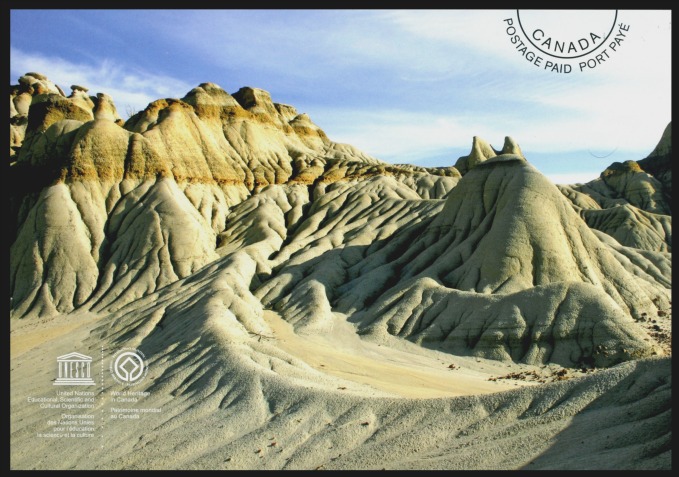
These Hoodoos are in the badlands of Alberta. They stand about one to three metres high and are weathered stone columns with sandstone caprocks. The problem with this stamp is that the Hoodoos are not in Dinosaur Provincial Park, but are actually near Drumheller, about 165 kms to the northwest. The stamp was issued on Friday, July 3rd and by Tuesday, July 7th were recalled. All the stamps in the booklet, including the other two in the series, Waterton National Park and Wood Buffalo National Park, were destroyed. By late August the set was re-released with the correct Dinosaur Provincial Park badlands photo. 
(seen here on this PrePaid Postcard)

for stamp oddities

21 February 2016

Sunday Stamps II - 62

2007, Canada Terra Nova National Park
designer: Saskia van Kampen
Photographer: Garry Black

Showing a sunrise over Alexander Bay, this stamp celebrates the 50th anniversary of Terra Nova National Park, the first national park in Newfoundland. The park is 400 square kilometres of rugged terrain that is part of the Appalachian Mountain System that extends from Newfoundland to Alabama.

for sunrise/sunset

14 February 2016

Sunday Stamps II - 61

2011, Israel - Rescue Forces
designer: Achva Kahana

This stamp celebrates the men and women of Israel's rescue forces who devote their time and energy to training and preparation in anticipation of an emergency situation - a natural disaster, accident, acts of terrorism or war - where their services might be needed. Members of the various rescue forces are responsible for evacuating the injured from the scene of an event, providing life saving treatment and speedy transfer to hospital as well as protecting the public from law breakers and terrorists. Many volunteers are active in each of the rescue organizations.

for red stamps

07 February 2016

Sunday Stamps II - 60


2003, Slovakia,  Biennial of Illustration Bratislava

The Biennial of Illustrations Bratislava (BIB) is an international competitive exhibition of illustrations for children's books.  Jana Kiselová-Siteková 'creates ethereal and fragile illustrations using fine colours, unusual techniques and microdrawings'. This stamps shows Hans Christian Anderson's Thumbelina (Palculienka in Slovak) which won a Golden Apple award for the BIB in 2001.

for illustrations

31 January 2016

Sunday Stamps II - 59

2014, Finland

A bridge over a snowy river with a low winter sun. Other than that, I could find no information about this stamp.

for winter scenes

24 January 2016

Sunday Stamps II - 58

2008, Russia,  7 rubles,
women's bicycle B-22, 1954
designed by V Beltyukov

The others in the set of four stamps for a history of Russian bicycles were from 1917, 1938, 1946.
This is the only one that is a women's bicycle.

for cycles

17 January 2016

Sunday Stamps II - 57

1978 USA wildlife from Canada/US border
CAPEX (Canadian Association for Philiatelic Exhibitions)
designed by Stanley Galli

Mallards are the most widespread and abundant duck in North America and are particularly plentiful in city and suburban parks where they can be very tame. They are a dabbling duck and are known for hybridizing with other dabblers. The standard duck 'quack' is the sound of a female mallard.


for water birds

10 January 2016

Sunday Stamps II - 56

1966, Spain F.N.M.T. (Fábrica Nacional de Moneda y Timbre - the Royal Mint)
one of a series from Castles of Spain
1 peseta

The Alcázar de Segovia started of as an Arab fort and has served as a royal palace, a state prison, an artillery college, and a military college. It is now a museum. Throughout the Middle Ages it was a favourite residence of the Castilian monarchs. Phillip II was married here and rumour has it Walt Disney used it as his inspiration for Cinderella's castle.
for castles or palaces

03 January 2016

Sunday Stamps II - 55

1974, commemorative stamp "Bridges and Rivers of Lesotho"

The Tsoelike Suspension Bridge was built in 1930 by the same company that built many of the most famous bridges in the UK, and the only one outside the UK,  Sir William Arrol & Co. based in Glasgow. It is still in use.

for bridges

27 December 2015

Sunday Stamps II - 54

2006, Netherlands, lenticular stamp
Speed skater Yvonne van Gennip who won three golds at the Calgary 1988 Winter Olympics. The short film on a stamp was created from a series of 12 film stills taken from the winning race and pieced together.

for a favourite stamp

20 December 2015

Sunday Stamps II - 53

1972 Great Britain,  Christmas Angles
issued 18 October 1972 and postmarked in Edinburgh from the Philatelic Bureau
photogravure
designer: Sally Stiff
2 1/2p  - Angel in pink with Trumpet
3p - Angel in blue with Lute
7 1/2p - Angel in brown with Harp

For Christmas stamps with a religious theme

16 December 2015

13 December 2015

Sunday Stamps II - 52

2015, USA
designed by Antonio Alcada
A Charlie Brown Christmas was first shown on television in 1965. For the 50th anniversary, the USPS has issued a booklet of stamps with 10 still frames from the animation. This one shows Charlie Brown with Linus and his Christmas tree. The "Forever/USA" is written in the same font as the Peanuts comic strip.

for secular Christmas stamps